
ARCHIVE 001 / AN OFFICIAL HISTORY OF SORTS
THE UNLIKELY HISTORY OF THE MINISTRY OF MINOR THINGS.
The Empire conquered the stars, then lost a spanner. Six months of meetings and five departments later, a very peculiar Ministry opened for business.
*The Ministry has never established which calendar was used.

FILE 01 / A CIVILISATION OF CONSIDERABLE ACHIEVEMENT
They conquered the stars. They still lost their keys.
By most reasonable measures, civilisation had been a success.
Humanity had crossed the distances between stars, conquered the more disagreeable diseases, and established a government so sophisticated that entire moons were dedicated to storing the decisions of committees whose members had been dead for centuries.
Almost everything had been anticipated.
Except, as it turned out, the little things.
A citizen could cross a solar system without noticing the journey, then spend an afternoon searching for spectacles resting on their head. A spacecraft could predict the movements of a thousand celestial bodies, but its captain might still forget why he had entered the engine room.
These were not considered serious problems.
That was the problem.
The matter finally reached the Imperial authorities following the Incident of the Missing Spanner. An engineer misplaced a small adjustable spanner at an orbital transport facility. Seventeen minutes of searching delayed an inspection, then a cargo departure, then several other departures, and eventually an emergency meeting of the Imperial Transport Commission.

The meeting lasted six months.
Its final recommendation was that someone should find the spanner.
By that time, the engineer had retired.
Three years later, the spanner was found in a drawer marked Miscellaneous, where the engineer had put it for safekeeping.
FILE 02 / AN INSTITUTION OF NEGLIGIBLE IMPORTANCE
When in doubt, establish a Ministry.
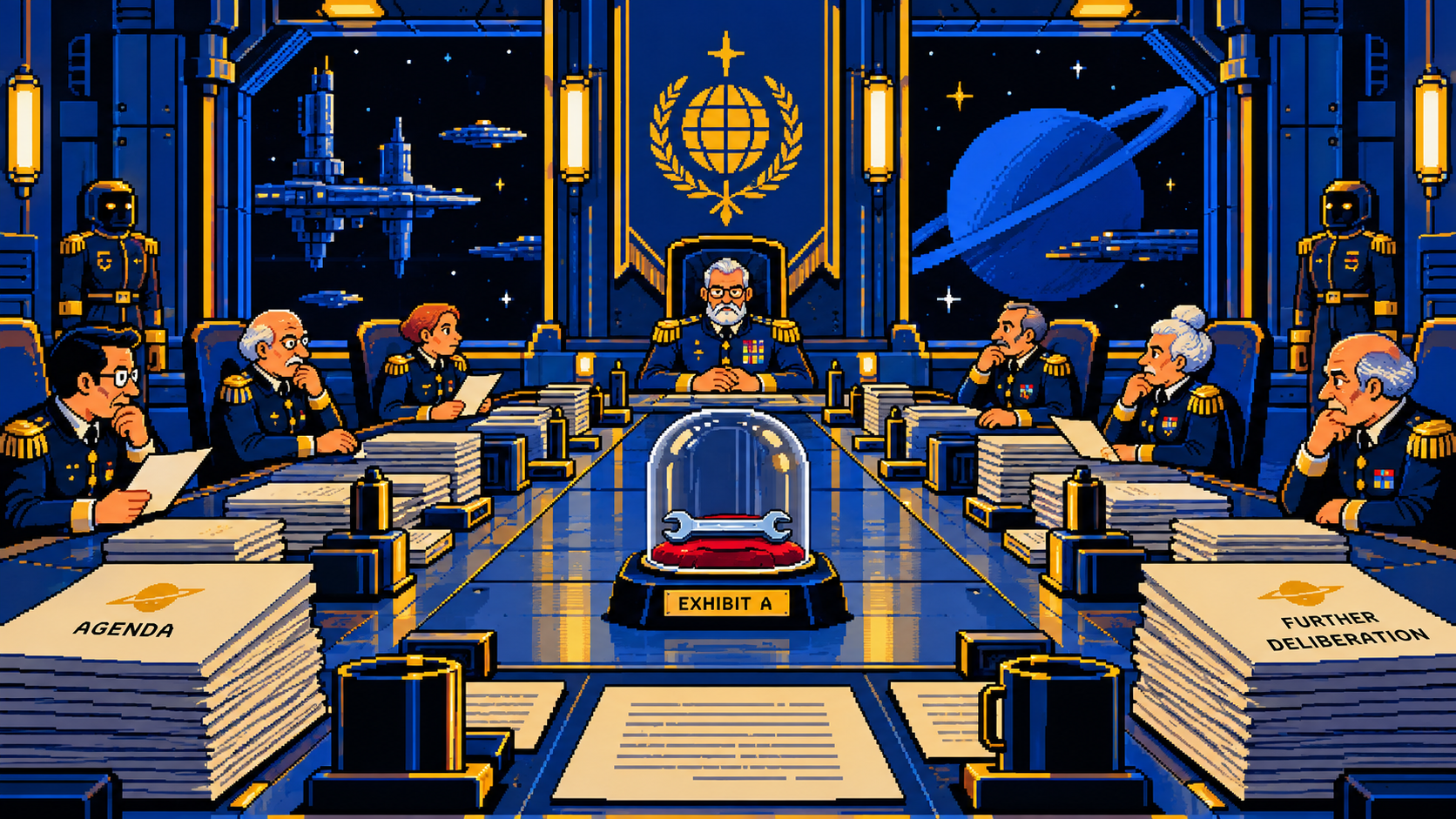
The Commission conducted an exhaustive inquiry. Its conclusion was simple: the problem was too small to fall within the jurisdiction of any existing department.
A new ministry was therefore required.
Thus, by Imperial Directive 001-M, the Ministry of Minor Things was established to identify, record and, where practicable, reduce the minor inconveniences of daily existence. The founding charter was immediately amended to add subject to available funding.
The Ministry was assigned a squat, steel-blue administrative outpost at the edge of inhabited space, well beyond the major trade routes and some distance from anywhere a sensible person might wish to visit. It came equipped with five departmental doors, several hundred storage rooms, an abandoned landing platform and a cafeteria closed for refurbishment since before the refurbishment department was abolished.
The official establishment year was recorded as 1988. Nobody could establish which calendar had been used. Accordingly, the Ministry has considered itself founded in 1988 ever since.
Its computer terminals displayed sixteen colours. When an engineer proposed upgrading them to several million, the request was rejected because nobody had yet established an administrative use for the first sixteen.
Even the doors were excessive: five enormous blast shutters salvaged from a military installation. Their requisition form explained the arrangement in two words:
SECURITY CLASSIFICATION: APPROPRIATELY EXCESSIVE.
The Ministry opened with one receptionist, five departmental heads and a budget sufficient for approximately forty-three minutes of useful work per day.
Against considerable odds, it has remained open.
FILE 03 / THE ART OF ARRIVAL
Mr. Quibble would like to know your business.
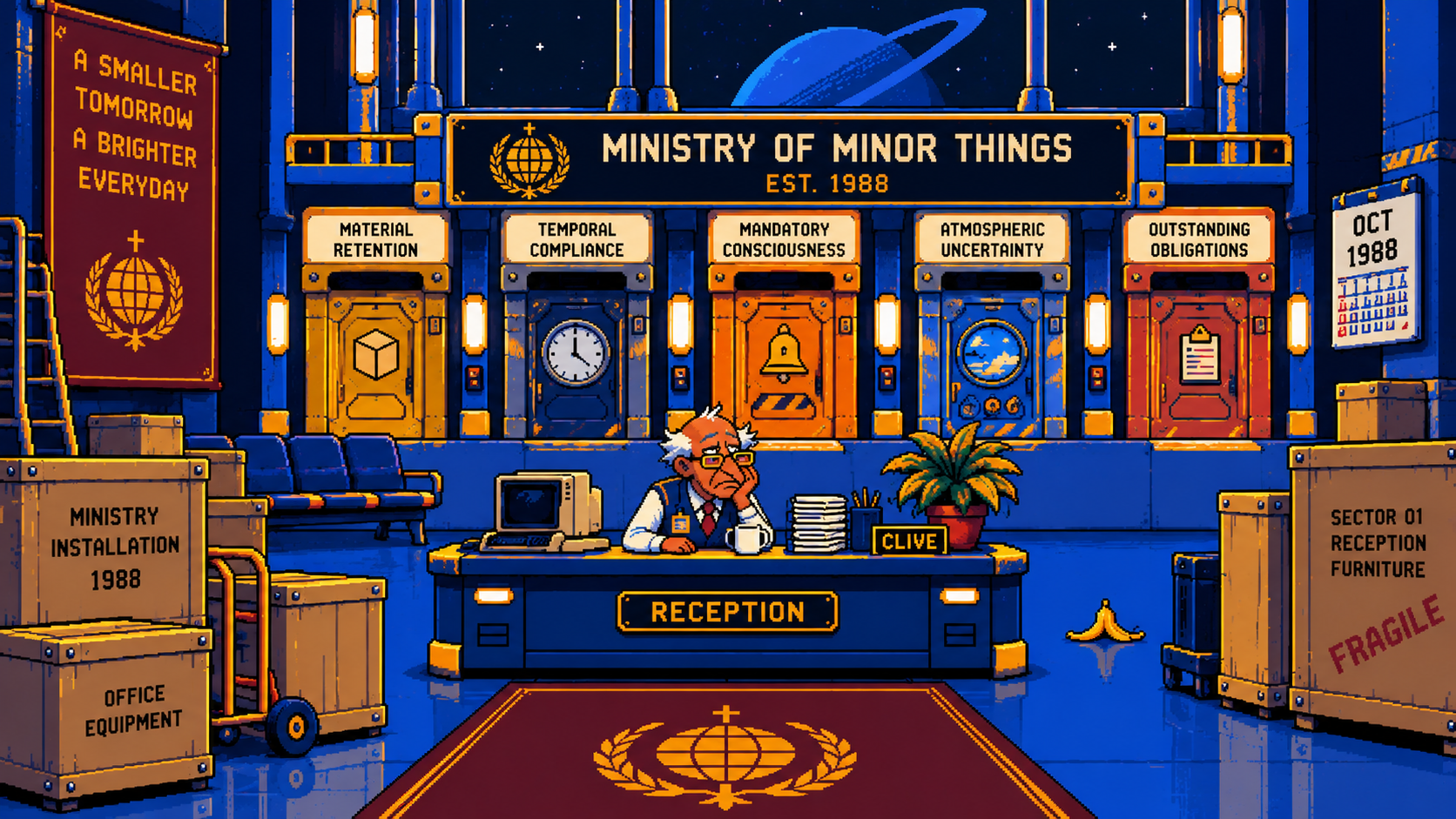
Every visitor to the Ministry passes Mr. Quibble's desk. He is a compact, carefully dressed man whose age is uncertain and whose coffee cup enjoys the unofficial status of an institutional fixture.
Mr. Quibble is devoted to helping people. He is equally devoted to making sure help proceeds through the proper channels. This occasionally presents difficulties.
“Purpose of visit?” he might ask.
“I've lost something.”
“Naturally. This is the Ministry of Minor Things.”
“Can you help?”
“That depends. Have you lost something, forgotten something, misplaced something, or failed to remember where something was placed?”
“What's the difference?”
Mr. Quibble leans forward.
“Jurisdiction.”
Beside his desk is Clive, a plant supplied under an abandoned employee-morale initiative. Clive's latest performance review described him as technically alive, but insufficiently enthusiastic. Quibble lodged an appeal on his behalf. It is now in its eighth year.
FILE 04 / FIVE DEPARTMENTS, FIVE OPINIONS
Behind the five doors.
Each department occupies a room considerably larger on the inside than the building's plans should permit. The architect called this advanced spatial engineering. Maintenance calls it a drawing error.
Walter Grimsby — Material Retention. Beyond Walter's door is a warehouse of seemingly endless shelves, crates and boxes. Walter is patient, melancholy and convinced that people are not foolish but optimistic. “Every person,” he explains, “believes that the place they have chosen is so sensible that they could not possibly forget it.” He considers this. “These people provide most of our business.”
Percival Tockwell — Temporal Compliance. His office ticks in several incompatible rhythms. Percival believes time is the Empire's most mismanaged resource. “Everyone receives the same twenty-four hours. Distribution is not the problem.” He dislikes the phrase in a moment and once tried to have it prohibited. The committee promised to consider it later.
Mabel Briskett — Mandatory Consciousness. Her office bristles with bells, lights and warnings, including a red button marked IMPORTANT and a smaller one marked MORE IMPORTANT. Mabel maintains that an important intention ought to be remembered at the appropriate moment. She has little patience for dismissed reminders. Her proposed policy on premature compliance has itself been delayed. She has set a reminder.
Nimbus Puddle — Atmospheric Uncertainty. Nimbus works beneath an indoor cloud that occasionally rains on the filing cabinets. “The clouds,” he says, “have not yet learned to consult the calendar.” His weather forecasts maintain a respectful uncertainty. This is not pessimism, he insists. It is meteorology.
Beatrice Dockett — Outstanding Obligations. Beatrice keeps the lists of things still to be done, and the lists of lists awaiting review. She believes completed tasks deserve acknowledgement. Her own oldest unfinished task is Take a day off. She refuses to remove it. “One must remain hopeful,” she says.
Walter's first useful discovery was that knowing an object had been lost was much less helpful than knowing where it had last been seen. His proposed remedy was almost offensively simple:
The best time to find something is before you have lost it.
Record what you put away and where you put it. When you need it, retrieve the record. Walter found this astonishingly effective. The Ministry found it insufficiently complicated. Approval took eleven years.

FILE 05 / AN EXTRAORDINARY CONSULTATION
The problem that didn't belong anywhere.
One afternoon, an older woman arrived at Mr. Quibble's desk carrying a canvas bag. She was preparing a small family gathering. She needed to find her mother's old music box, finish the preparations before Saturday, remember several promises, and hope the weather stayed fine.
“What would you like the Ministry to do?” asked Quibble.
“Help me get organised, I suppose.”
There was no department for getting organised, I suppose. The appropriate form had been discontinued, and its replacement was not yet available.
Quibble studied the woman. She simply wanted to do something kind for her family. He considered sending her elsewhere. Instead, he did something unprecedented.
He summoned all five department heads.
Walter came with index cards. Percival arrived three minutes early and complained that everyone was late. Mabel set an alarm on the table. Nimbus arrived damp. Beatrice began recording the meeting as an outstanding obligation.
Walter wanted a record of the music box. Percival calculated the time remaining until Saturday. Mabel proposed reminders. Nimbus suggested a forecast. Beatrice started a list.
They discussed the matter for forty-seven minutes. Percival confirmed the figure.
Then Quibble interrupted.
“Colleagues, you have each explained which part of the problem belongs to your department.”
“That is our responsibility,” said Beatrice.
“Yes. But the visitor doesn't have five problems.”
He looked around the table.
“She has one problem. She wishes to organise a family gathering. She needs to remember things, find things, do things, and arrange them at the right time, under conditions she cannot entirely control.”
“That sounds like weather,” said Nimbus.
“Not exclusively weather,” Percival replied.
And for once, the Ministry's officials were silent. Real life, they realised, had very little interest in their departmental boundaries.
They needed to make the useful part simple, even if the surrounding bureaucracy remained magnificently absurd.

FILE 06 / A PORTABLE MINISTRY
Small apps. An enormous bureaucracy.
The meeting produced an internal paper with an impressive title: A Preliminary Framework for the Coordinated Reduction of Domestic Inconvenience. It was eventually shortened to Helpful Things.
One proposal changed everything. Instead of requiring citizens to travel to the edge of the Empire whenever they lost their keys, the five departments would put their services onto the small devices people already carried.
Mr. Quibble was concerned. “They might no longer need to pass through reception.”
“They could still visit,” Walter replied.
“Voluntarily?”
“Of course.”
Quibble considered this. “How unusual.”
The first application was GRIMSBY. Walter discarded the proposal's more extravagant features and kept only what mattered: photograph an object, record where it was put, and find that record when it was needed.
The other departments are preparing TOCKWELL for time, BRISKETT for reminders, PUDDLE for weather and DOCKETT for unfinished tasks. Their progress is steady, within the Ministry's understanding of the word.
The building has barely changed. The doors still close with unnecessary force. The computers still display sixteen colours.
And sometimes, a visitor returns to say thank you.
When the woman with the music box came back, she told Quibble that the gathering had gone beautifully. The box had been found under the stairs, behind the Christmas decorations. She had taken a photograph of its new location. Her daughter had loved it.
“You know,” she said, “it's funny. It was only a little thing.”
Quibble glanced towards the five departmental doors.
“Madam,” he said, “we have found that most things are.”
After she left, he took a blank form and wrote To say thank you under PURPOSE OF VISIT. For the first time in many years, he chose not to assign it a classification number.
Instead, he placed it in the top drawer of his desk.
Somewhere safe.
At the edge of civilisation, a terminal gave a cheerful beep. Quibble looked up.
“Ah,” he said. “Someone has opened another door.”
He straightened his collar, set down his coffee and prepared to be helpful.
Which, in the Ministry of Minor Things, is rather more revolutionary than it sounds.